

Two of the most commonly confused maintenance services in the automotive world are tire balancing and wheel alignment. While both relate to how your tires interact with the road, they address completely different problems and require different solutions. Understanding the distinction between tire balancing and wheel alignment can save you time, money, and a lot of unnecessary frustration at the repair shop.
What Is Tire Balancing?
Tire balancing is the process of equalizing the weight distribution around each tire and wheel assembly. Even brand-new tires are not perfectly uniform in weight. Small variations in the rubber, the wheel itself, or the valve stem can create imbalances that become noticeable once the vehicle reaches higher speeds. When a tire is out of balance, it does not spin evenly, which causes it to bounce or wobble as it rotates. The result is typically a vibrating sensation that you feel through the steering wheel, the floorboard, or the seat.
To perform tire balancing, a technician mounts each wheel on a specialized balancing machine that spins it at high speed to detect heavy spots. Once identified, small counterweights are attached to the rim to offset those heavy areas and bring the tire into equilibrium. The entire process is relatively quick, usually taking under an hour for all four tires.
Tire balancing should be done every 5,000 to 6,000 miles, or whenever you install new tires. It is also a good idea to have your tires balanced if you notice vibrations, uneven tread wear, or after hitting a significant pothole or curb. Ignoring an imbalance does not just create an uncomfortable ride; it also puts extra stress on your wheel bearings, shocks, and struts, leading to more expensive repairs down the line.
What Is Wheel Alignment?
Wheel alignment, sometimes called tire alignment, is a completely different service that involves adjusting the angles of your tires so they make proper contact with the road and point in the correct direction. Over time, your vehicle’s suspension system can shift due to normal wear, road conditions, or impacts like hitting a curb or pothole. When the suspension is out of its proper position, your tires no longer sit at the correct angles, which throws off the entire handling of the vehicle.
There are three main angles that technicians measure and adjust during an alignment: camber, toe, and caster. Camber refers to the inward or outward tilt of the tire when viewed from the front of the vehicle. Toe describes whether the tires point inward or outward when viewed from above. Caster relates to the angle of the steering axis when viewed from the side and affects steering stability and handling. When any of these angles fall outside of the manufacturer’s specified range, your vehicle will not handle the way it was designed to.
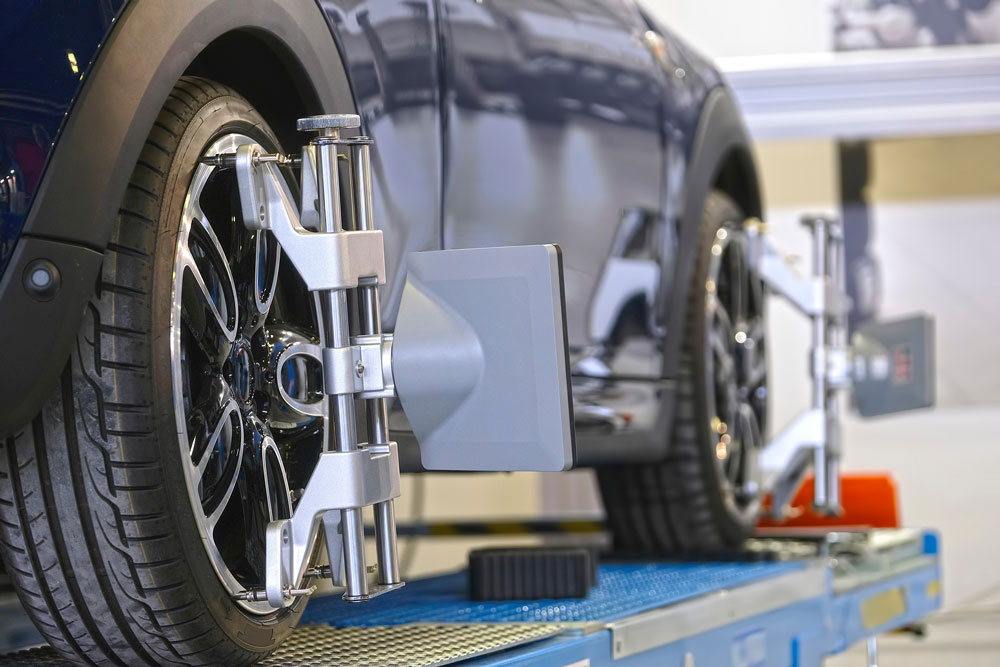
Common signs that you need a wheel alignment include your car pulling to one side, uneven tire wear (particularly when one edge of the tire wears faster than the other), a crooked steering wheel when driving straight, or a generally loose and wandering feeling when steering. A proper alignment service uses a computerized alignment machine that measures all four wheels simultaneously and allows the technician to make precise adjustments to bring everything back into factory specifications.
Wheel alignment is typically recommended every one to two years, or after any significant suspension impact. It is also strongly advised whenever you install new tires, since starting with a proper alignment protects your investment and ensures even wear across the tread life.
Key Differences Between Tire Balancing and Wheel Alignment
Although tire balancing and wheel alignment are both essential for tire health and vehicle performance, confusing the two is easy when you are not familiar with what each one does. The simplest way to think about it is this: tire balancing deals with the weight of the wheel and tire assembly, while wheel alignment deals with the angles and direction of the tires in relation to the vehicle and the road.
Tire balancing corrects vibrations caused by uneven weight distribution. Wheel alignment corrects handling and steering issues caused by misaligned suspension angles. The tools used are different, the symptoms are different, and the problems they fix are different. However, both services complement each other, and it is common for shops to perform them together, especially when installing new tires.
Another key difference is what happens when each problem is ignored. An unbalanced tire primarily causes wear and vibration. A misaligned wheel, on the other hand, can cause rapid and uneven tire wear that shortens the lifespan of your tires significantly. Misalignment also places strain on your suspension components and can affect fuel efficiency, since tires that are not pointing in the right direction create more rolling resistance.
How Often Should You Get Each Service?
Understanding how often to schedule tire balancing and wheel alignment services is just as important as understanding what they do. Staying on top of both helps extend the life of your tires, improves your gas mileage, and keeps your vehicle handling safely.
For tire balancing, most automotive professionals recommend a balance check with every oil change, or at minimum every 5,000 to 6,000 miles. If you frequently drive on rough roads or have experienced any impacts to your wheels, it makes sense to have them checked sooner. Some tire manufacturers even require proof of regular balancing to honor their tread wear warranties, so keeping records of your service history is a smart habit.
For wheel alignment, the general recommendation is once a year for most drivers, though vehicles with high mileage or those driven on rough terrain may need it more frequently. You should always get an alignment after replacing suspension components, after a collision, or after any event that may have shifted your suspension geometry. New tire installations are another ideal time to check alignment, since fresh tires on a misaligned vehicle will begin wearing unevenly almost immediately.
It is worth noting that some vehicles, particularly those with performance-oriented suspension setups, may require more frequent alignment checks simply because the tighter tolerances involved make them more sensitive to any changes. If you are unsure how often your specific vehicle needs either service, consulting your owner’s manual or a trusted technician is always a reliable approach.
Conclusion
Tire balancing and wheel alignment are two distinct services that work together to keep your vehicle running smoothly, safely, and efficiently. Tire balancing addresses uneven weight distribution in the wheel assembly to eliminate vibrations, while wheel alignment corrects the angles of your tires to ensure proper contact with the road and stable handling. Both services are relatively affordable compared to the damage that neglecting them can cause over time. By staying proactive with tire balancing and wheel alignment, you protect your tires, your suspension, your fuel economy, and most importantly, your safety on the road.
Need a Local Mechanic Near You?
For over 107 years, our family owned and operated team at Olesen Auto Center, Inc. has proudly served our community with dependable automotive solutions you can trust. We offer a wide selection of used cars, trucks, and vans, along with several options for new tires to keep your vehicle road ready. Our experienced mechanics also provide competitively priced services including routine maintenance, transmission and engine repairs, heating and A/C service, wheel bearings, brake work, tire patching, and more. Whether you are searching for a reliable used vehicle or need expert care for the one you already drive, we are here to help. Contact us today to learn how we can get you back on the road with confidence!